

close
Choose Your Site
Global
Social Media
Views: 0 Author: Site Editor Publish Time: 2026-10-24 Origin: Site


Picture a fully optimized servo-driven packaging line humming along at peak capacity. It is perfectly synchronized to meet tight shipping deadlines. Suddenly, the entire operation grinds to a halt. The culprit is not a mechanical failure or a software glitch. A standard 40-pound strapping coil has simply run empty. This frustrating sequence plays out multiple times a shift in facilities across the globe. It acts as a silent profit killer. For plant managers and packaging engineers, machine downtime caused by frequent strapping coil changeovers is a critical bottleneck. It demands an immediate systemic solution.
Automated high-speed packaging lines rely fundamentally on continuous operation. Every interruption disrupts this delicate flow. Upstream accumulation and downstream delays inevitably follow. Transitioning to massive coil formats presents the ultimate operational upgrade for minimizing these stops and maximizing overall throughput. By understanding how these massive coils calculate into significant returns on investment, facilities can permanently eliminate this common production hurdle.
Downtime Reduction: Massive coils hold three to four times more material than standard rolls. This effectively slashes changeover frequency by up to 75 percent.
Labor Efficiency: Fewer roll changes liberate machine operators. They can focus on vital quality control and line management rather than repetitive manual material handling.
Automation Synergy: High-capacity material feeds are perfectly suited for modern PLC-integrated automated strapping machines. They ensure consistent tension without feed spikes.
Cost Savings: A lower cost per foot of strap combined with drastically reduced plastic scrap yields a rapid and measurable return on investment.
Equipment Upgrades: Utilizing massive strapping coils requires the installation of specific heavy-duty accumulator-equipped dispensers. The integration process remains seamless for most existing packaging lines.
To build a compelling business case for an operational upgrade, facility leaders must first quantify the exact financial impact of their current material limitations. Consider the daily mathematics of a high-volume line. A standard roll change requires an operator to halt the machine and remove the empty cardboard core. They must then fetch a new 50-pound coil, thread the machine, and clear the initial feed. This process takes roughly five to ten minutes. The accumulated time is staggering. A line requiring eight changeovers per shift will suffer up to 80 minutes of lost production daily. Over a standard working month, this equates to dozens of hours where expensive capital equipment sits completely idle.
Beyond the raw calculation of lost minutes, frequent stops create a cascading effect of bottlenecks at the end-of-line packaging stage. When an operator is distracted by the physical task of wrestling with a new strapping coil, they are pulled away from monitoring package integrity. Label placement and overall system health suffer as a direct result.
Current industrial manufacturing trends reveal a massive paradigm shift in how modern plant managers approach end-of-line packaging. The broader sector is moving rapidly toward lights-out automation principles. The ultimate goal is minimizing human intervention. In this context, upgrading the upstream material delivery system is recognized as one of the most effective strategies to unlock hidden Overall Equipment Effectiveness gains. A continuous material feed directly boosts machine availability scores.
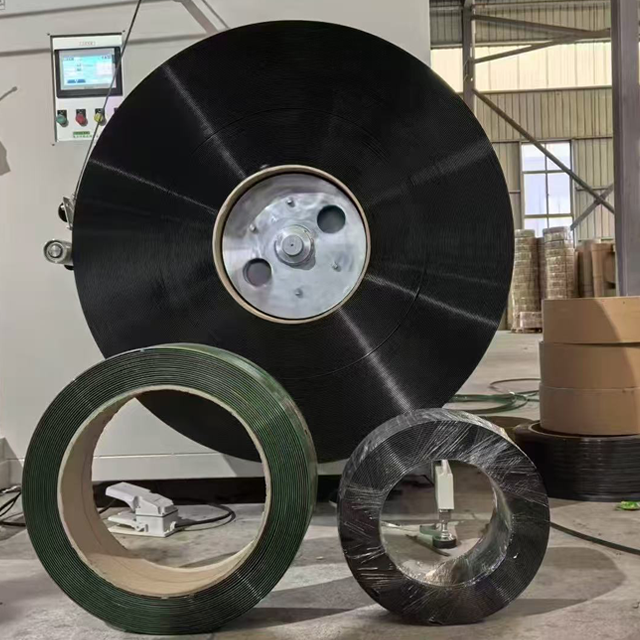
From an engineering standpoint, the primary distinction between decentralized banding and a continuous coil setup is the massive spool volume. Standard strapping coils are historically designed around the limitations of manual human labor. Typically wound on a 16-inch by 6-inch core, these rolls weigh between 40 and 50 pounds. This makes them safe for an operator to lift and load onto a basic unpowered cart. They generally yield around 4,000 to 6,000 feet of material depending on the strap thickness.
In stark contrast, jumbo roll PET strapping breaks free from ergonomic lifting constraints. These products are designed exclusively for mechanical loading. Wound on significantly larger cores, these massive rolls weigh anywhere from 150 pounds to well over 400 pounds. Consequently, the continuous footage skyrockets. A single massive roll can easily exceed 15,000 feet of material. This massive increase in capacity transforms a packaging line from operating in short bursts to running continuously across multiple shifts.
Specification Feature | Standard PET Coil | Jumbo PET Coil |
|---|---|---|
Core Size | 16-inch by 6-inch | 16-inch by 8-inch or larger |
Average Weight | 40 to 50 pounds | 150 to 450 pounds |
Yield per Roll | 4,000 to 6,000 feet | 15,000 to 30,000+ feet |
Loading Method | Manual operator lift | Forklift or overhead hoist |
Changeover Frequency | 6 to 10 per shift | 1 to 2 per shift |
Polyester has largely usurped traditional steel banding in heavy-duty applications. This dominance is especially apparent in large-format rolls. Polyester offers a unique combination of high tensile strength and elastic memory. It stretches slightly under dynamic transit loads and then recovers to keep the load tightly secured. Furthermore, polyester does not rust. It eliminates the risk of sharp edges injuring operators and is highly resistant to ultraviolet degradation. While many facilities still successfully utilize standard polyester rolls for lighter decentralized packing stations, the transition to massive continuous polyester coils is the definitive standard for centralized automated production environments.
The operational mechanics of oversized coils are straightforward yet highly effective. By providing a massive uninterrupted supply of high-volume polyester packing strap, a packaging line can run continuously for days rather than hours. This sustained operation dramatically alters shift productivity. Every time a roll ends, there is a risk of the tail end of the strap causing a misfeed. A new strap threaded improperly leads to machine jams. By reducing the frequency of end-of-roll transitions by 75 percent, facilities inherently reduce the statistical probability of these frustrating time-consuming errors.
Modern automated strapping heads are marvels of engineering. They utilize Programmable Logic Controllers and highly responsive servo drives to pull, tension, weld, and cut strap in a matter of milliseconds. These sophisticated heads are incredibly hungry for material. Massive rolls are the perfect match for this technology. Because the material is drawn from a continuous large-diameter source via an accumulator, the servo motors experience a smooth consistent feed. This eliminates the erratic tension spikes that can occur when a standard lightweight coil is jerked to a start by the strapping machine feed cycle.
The advantages of upgrading extend far beyond the immediate recovery of lost time. They directly impact the bottom line. Purchasing large roll PET banding inherently leverages economies of scale. Manufacturers spend less time and material spooling standard cores. This allows them to offer massive formats at a reduced cost per foot. Procurement teams combine this bulk purchasing discount with the hard financial savings of recovered labor hours and increased machine output. Consequently, the Total Cost of Ownership for the packaging line drops significantly.
Sustainability and waste reduction are increasingly critical metrics for modern manufacturing plants. Every single time a standard roll is changed, the operator must pull several feet of strap through the machine chute to prime the feed wheels. This material is subsequently cut off and thrown away. If a facility executes ten changeovers a day, that equates to hundreds of feet of wasted virgin plastic every week. By minimizing changeovers, facilities drastically reduce this end-of-roll scrap. Purchasing larger rolls also means consuming far fewer cardboard cores and associated protective packaging used during shipping.
It might seem counterintuitive that a 400-pound coil is safer for workers than a 50-pound coil. The reality lies entirely in the handling method. Standard coils require repetitive manual lifting, bending, and twisting. These actions are the primary causes of ergonomic workplace injuries. Massive rolls completely eliminate manual handling. They are loaded directly onto heavy-duty dispensers using forklifts, overhead hoists, or mechanized pallet jacks. The operator simply guides the machinery. This keeps their hands and backs safe from heavy repetitive strain.
The construction materials sector is characterized by incredibly heavy rigid loads that require thick high-tensile strapping. Because the strap itself is thicker, a standard-sized coil will hold very little actual footage. This forces constant changeovers. Massive rolls are absolutely essential in lumber yards and brick manufacturing plants. They keep high-speed compression strappers fed with enough material to maintain production quotas.
As the metals industry continues its massive migration away from traditional steel banding toward heavy-duty polyester, continuous material feed has become paramount. Facilities producing slit steel coils, aluminum extrusions, or heavy metal piping rely on massive rolls. They keep continuous production lines moving without the dangerous and time-consuming interruptions associated with handling sharp steel bands.
In the fast-paced world of corrugated cardboard manufacturing and agricultural baling, the sheer volume of product passing through the strapping arch is staggering. These lighter expanding loads may not require the thickest strap, but they consume material at an astonishing rate. In these high-speed logistics environments, standard rolls would run out in mere hours. Massive capacity becomes a non-negotiable requirement for profitability.
Transitioning a high-volume packaging line to accommodate larger material formats requires a precise understanding of technical specifications. Plant managers and packaging engineers must rigorously evaluate specific load containment requirements before selecting a strap. The physical properties of the strapping must align flawlessly with the mechanical capabilities of the automated strapping head. They must also match the dynamic stresses the load will experience during transit.
The structural integrity of polyester strapping is dictated by its cross-sectional area and the specific polymer blend used during the extrusion process. In industrial applications, strap widths typically range from 3/8 inch to 1-1/4 inches. Thicknesses vary between 0.020 inches and 0.050 inches.
Breaking strength indicates the maximum tensile load the strap can withstand before failing. However, breaking strength alone is not the sole indicator of performance. Engineers must also consider the working range or retained tension. When a load shifts or settles during transit, high-quality polyester maintains its tension due to its exceptional elastic memory. This is a distinct advantage over steel banding which may permanently stretch and loosen.
To assist procurement officers in standardizing their material requests, the following specifications reflect typical industrial applications. A 1/2 inch by 0.020 inch strap offers 600 pounds of breaking strength. It is ideal for light to medium corrugated boxes and standard palletizing. A 5/8 inch by 0.030 inch strap provides 1,400 pounds of breaking strength. This specification is suited for heavy appliances, beverage distribution, and securing rigid loads. A 3/4 inch by 0.040 inch strap delivers 2,000 pounds of breaking strength. This is strictly necessary for lumber, brick, block, and heavy construction materials. Finally, a 1 inch by 0.040 inch strap exceeds 2,500 pounds of breaking strength. This heavy-duty material is reserved for metals, steel coils, and heavy machinery transport.
The selection process must be driven by empirical data regarding load weight, load type, and transportation methods. Over-specifying the strap results in unnecessary material costs. Under-specifying risks catastrophic load failure and severe safety hazards.
When evaluating high-capacity materials, facility engineers should meticulously calculate the required joint strength. Friction-weld strapping heads typically achieve a joint efficiency of 75 to 85 percent of the total breaking strength of the strap. Therefore, if a heavy load requires 1,000 pounds of containment force, the selected strap must have a minimum breaking strength of approximately 1,300 pounds. This safely accounts for the joint weld variance.
The integration of massive coils into an existing packaging line presents specific mechanical challenges that cannot be ignored. While a standard 40-pound coil can be effortlessly manually loaded onto a basic unpowered cart, a massive coil demands specialized material handling equipment. Attempting to mount a massive roll onto standard dispensing equipment will result in immediate and spectacular failure. The automated strapping head simply cannot pull against the dead weight and high inertia of a heavy coil. The strap will snap, the feed wheels will slip, or the internal motors of the machine will burn out. Therefore, upgrading the dispensing mechanism is a mandatory technical requirement.
The core technology that enables the use of massive strapping coils is the powered dispenser equipped with an accumulator system. This robust equipment acts as a vital mechanical bridge between the heavy coil and the high-speed strapping head. A heavy-duty dispenser operates on an independent power supply. It utilizes its own dedicated motor to unspool the strap. Rather than feeding directly into the strapping machine, the dispenser feeds the material into an accumulator box or a specialized series of tensioning pulleys.
The accumulator stores a buffer of loose strapping. It often maintains 10 to 20 feet of slack material ready for instant use. When the automated strapping machine initiates a rapid cycle, it pulls the strap smoothly from this loose buffer rather than violently pulling against the heavy stationary coil. As the strapping machine consumes the slack buffer, internal limit switches or photoelectric eyes detect the drop in material. The dispenser motor then activates. It smoothly rotates the heavy coil to replenish the accumulator box before gracefully shutting off again.
A common misconception among plant managers is that transitioning to larger coils requires ripping out and replacing the entire automated strapping machine. In the vast majority of industrial scenarios, this is entirely incorrect. The upgrade process is highly modular and non-invasive. Modern automated strapping machines are inherently designed to accept strap from an external source. Integrating a new heavy-duty dispenser involves a few straightforward technical steps. First, the powered dispenser is positioned adjacent to the strapping machine to ensure a smooth feed path. Next, the strap is routed from the accumulator of the dispenser through a protective conduit and directly into the standard inlet chute of the strapping machine.
Upgrading to massive continuous rolls is one of the most effective and immediate methods to boost packaging line efficiency. By providing a massive uninterrupted supply of material, facilities can dramatically minimize machine stops and improve overall throughput.
Fewer changeovers directly translate to lower labor costs. Operators can focus on critical line management rather than wrestling with empty cardboard cores. While the transition does require an initial investment in heavy-duty accumulator-equipped dispensers, these units integrate seamlessly with existing automated machinery. This deceptively simple material change delivers a highly measurable operational advantage. Plant managers are strongly encouraged to evaluate their current daily downtime costs to see the undeniable financial benefits of this upgrade.
Standard polyester strapping coils weigh between 40 and 50 pounds. This weight is specifically designed to adhere to standard occupational safety limits for manual human lifting. Massive continuous rolls range significantly in weight depending on the core diameter and total continuous footage. A medium-capacity large roll might weigh 150 pounds. Ultra-high-capacity rolls used in continuous steel, brick, or lumber operations can easily exceed 400 pounds.
Yes. Due to the substantial weight and bulk of these massive coils, manual lifting is neither safe nor feasible. Facilities must use mechanical assistance to load the rolls onto the heavy-duty dispenser. This is typically accomplished using a standard warehouse forklift, a mechanized pallet jack, or an overhead hoist system. Heavy-duty dispensers are specifically engineered with these loading parameters in mind.
In almost all industrial scenarios, yes. The automated strapping machine operates entirely independently of the roll size, provided the physical dimensions of the strap remain identical to what the machine is calibrated for. However, you absolutely cannot feed a massive roll directly into the machine. You must invest in a standalone powered dispenser equipped with an accumulator.
No. High-quality polyester strapping is manufactured with specific polymer rheology that gives it excellent elastic memory and elongation recovery. The physical properties of the strap are permanently set during the extrusion and molecular orientation process. Whether the strap sits on a 40-pound coil or a massive 400-pound coil, it will maintain its structural integrity over time.
The exact run time depends entirely on the cycle speed of your packaging line and the length of strap consumed per cycle. However, a massive roll holding 15,000 feet of material will typically run three to four times longer than a standard coil. For a high-speed corrugated line, this often translates to extending changeover intervals from once every hour to once every half shift.
An accumulator acts as a mechanical buffer between the heavy stationary coil and the fast-moving strapping head. It stores 10 to 20 feet of slack strap. When the strapping cycle starts, the machine pulls from this slack rather than fighting the dead weight of the 400-pound roll. Sensors detect when the slack is low and trigger the dispenser motor to unspool more material into the accumulator.
Eliminating machine downtime starts with selecting the right high-capacity materials for your specific automated systems. Evaluate your current load requirements and explore the full range of heavy-duty strapping solutions tailored for continuous industrial operations. Visit PET Packing Strap today to audit your current equipment and find the exact specifications needed to keep your production lines moving without interruption.


