

close
Choose Your Site
Global
Social Media
Views: 0 Author: Site Editor Publish Time: 2026-06-30 Origin: Site


Long-distance freight exposes pallets to intense dynamic stresses daily. Sudden braking, prolonged vibration, and extreme temperature shifts constantly attack your cargo. These brutal conditions quickly expose the limits of traditional packaging materials. Your shipments face relentless physical punishment from departure to arrival. Ordinary bands simply cannot survive these extreme logistical environments.
Shippers historically rely on steel for exceptionally heavy loads. They often use polypropylene for much lighter duties. However, neither material handles the continuous kinetic energy of long-haul transit well. Steel snaps violently under heavy shock. Polypropylene stretches permanently and loses its grip. Neither option guarantees absolute cargo stability across thousands of miles.
You need a material built specifically for extreme, unpredictable movement. Polyester PET Strapping has emerged as the clear industry standard for securing long-distance cargo. It offers a highly unique combination of elongation recovery, massive break strength, and operational safety. Read on to discover why this advanced polymer protects your valuable goods better than legacy alternatives.
Shock Absorption: PET dynamically expands and retracts to absorb transit impacts, keeping loads secure where steel would snap or loosen.
Superior Memory: Unmatched PET strap tension retention prevents load shifting caused by settling cargo over multi-day journeys.
Cost & Safety ROI: Switching to PET reduces material costs by up to 40% compared to steel, while virtually eliminating worker laceration risks.
Weather Resistance: Unlike steel (which rusts) and PP (which degrades quickly under UV), PET maintains structural integrity across diverse climate zones.
Long-distance transit punishes cargo relentlessly. Physical forces attack packaged pallets from multiple directions. We call this constant assault dynamic load stress. Your shipments must survive a brutal gauntlet of environmental and physical challenges. Traditional packaging often fails under these precise conditions. You must understand these forces to protect your inventory properly.
Consider the varied impacts across different transport modes:
Road Vibrations: Heavy trucks navigate uneven highways. These constant vibrations travel directly into stacked pallets.
Rail Impacts: Train cars slam together in humping yards. These massive kinetic shocks easily fracture rigid packaging.
Ocean Swell: Cargo ships pitch and roll continuously. This creates a relentless swaying motion over several weeks.
Cargo also settles naturally over time. Corrugated boards compress under heavy stacked weight. Wooden crates shift slightly during transit. Bagged goods flatten as vibrations shake them down. This natural settling instantly creates slack in rigid straps. Rigid bindings suddenly become dangerously loose. The entire load loses vital structural integrity. Loose pallets tip over easily.
Thermal expansion complicates long transit routes further. Cross-country shipments pass through multiple extreme climate zones. They move from freezing mountains to scorching deserts in days. Extreme temperatures heavily stress your packaging materials. Materials naturally expand in extreme heat. They shrink rapidly in freezing cold. This thermal cycling ruins unstable straps.
Packaging failure carries a massive business cost. Receivers aggressively reject unstable, leaning pallets. Damaged goods destroy your profit margins instantly. Unsafe loads create severe physical liabilities for warehouse workers. Distribution centers must repackage broken pallets manually. This tedious process wastes precious facility time. It devours operational budgets and damages customer relationships.
You must evaluate material behavior under extreme stress. Compare polyester directly to traditional steel. Steel is a highly rigid, unyielding metal. It completely lacks physical memory. A shifted load instantly stresses a steel band. The steel either snaps completely or stretches permanently. It cannot bounce back to its original shape. The cargo remains dangerously loose.
Polyester behaves entirely differently. It actively absorbs massive kinetic shocks. It then recovers its original tensioned shape. Steel also suffers massive environmental damage over time. Moisture causes rapid oxidation on metal surfaces. Rust forms quickly on exposed steel bands. This rust permanently stains valuable cargo. You lose significant inventory value. Polyester remains totally impervious to rust.
Next, we must compare polyester to polypropylene (PP). Polyester boasts significantly higher tensile break strength. You can secure heavy-duty building materials safely. PP works only for lightweight cardboard boxes. PP also suffers from severe material creep. We define creep as continuous tension loss over time. PP bands lose their tight grip gradually.
This creep makes PP totally unsuitable for long transit times. It simply cannot hold heavy cargo across continents. PP also degrades quickly under ultraviolet light. Outdoor storage destroys its holding power. Polyester resists UV degradation exceptionally well. It maintains strict structural integrity in open flatbed transport. It outperforms legacy materials across every major metric.
Packaging Material Performance Chart
Performance Feature | Steel Bands | Polypropylene (PP) | Polyester (PET) |
|---|---|---|---|
Shock Absorption | Very Poor (Breaks) | Moderate (Stretches) | Excellent (Recovers) |
Tension Memory | None | Low (High Creep) | High (Elastic Recovery) |
Weather Resistance | Poor (Rusts Easily) | Poor (UV Degradation) | Excellent (UV & Moisture Safe) |
Worker Safety | Dangerous (Lacerations) | Safe | Safe |
Best practices dictate matching material to the exact transit mode. Do not use PP for anything traveling over ocean waters. Use steel only for extremely hot, sharp-edged metallurgy. Rely on polyester for virtually every other palletized load. This simple framework prevents countless shipping disasters. It streamlines your procurement decisions effectively.
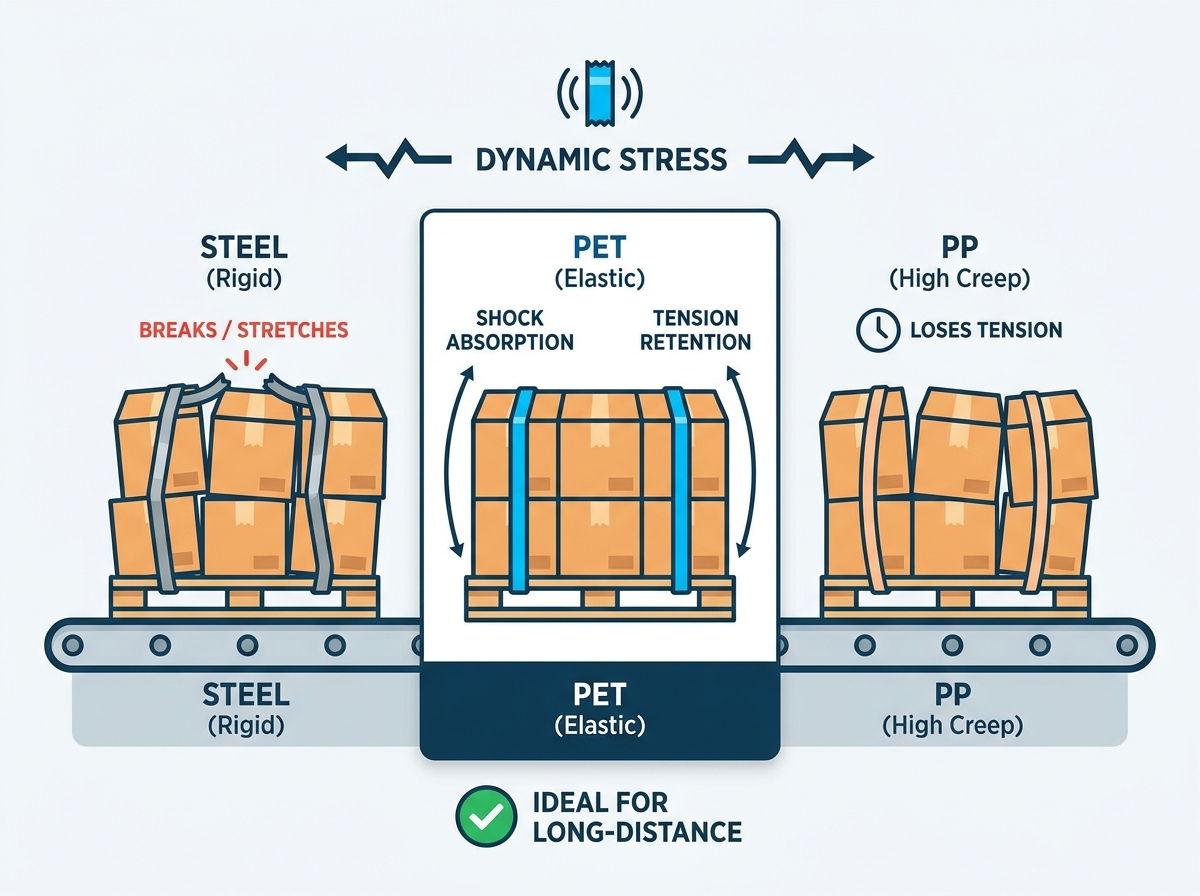
Elastic recovery fundamentally defines superior transit packaging. Polyester elongates by 2% to 6% during a heavy impact. More importantly, it recovers up to 98% of this specific elongation. We proudly call this superior elastic memory. This unique characteristic functions exactly like a heavy-duty industrial rubber band. It acts as an active, dynamic securing mechanism.
This dynamic recovery prevents total disaster during long hauls. Packaged goods frequently settle during a rough journey. Cardboard cartons compress slightly under load. The physical footprint of the pallet shrinks. PET strap tension retention counteracts this settling problem perfectly. The band actively shrinks right alongside the settling cargo. It maintains continuous holding force.
The pallet stays locked tight despite changing dimensions. A rigid material would simply hang loosely around the shrunken load. This continuous holding force guarantees safe arrival. It prevents individual boxes from sliding off the stack. We highly recommend testing this behavior in your own facility. You will immediately notice the tight grip after impact.
Industry experts measure this retention scientifically. Standard tension metrics thoroughly evaluate hold force over time. The ASTM D3950 testing framework routinely benchmarks these specific packaging materials. Polyester consistently outperforms rigid alternatives in these rigorous tests. It retains high tension for many months in storage. This specific characteristic makes it superior for long-distance logistics.
A common mistake involves ignoring initial tension application. You must apply sufficient initial tension to activate the memory. Under-tensioned bands will not recover properly after an impact. We advise using calibrated pneumatic tools. These tools guarantee the correct initial stretch. Proper calibration unlocks the full scientific potential of the material.
Upgrading your packaging yields truly excellent financial returns. We consistently see massive direct material savings for shippers. Polyester costs much less per foot than traditional steel. You frequently save 20% to 40% on procurement alone. These immediate cost reductions improve your departmental bottom line immediately. You spend less money securing the exact same loads.
Freight weight reductions also add up rapidly. Polyester is roughly 80% lighter than its steel equivalent. You save crucial tare weight on every single pallet. These marginal weight savings compound quickly on long-haul transport. You ultimately ship more actual product and much less dead packaging. Fuel surcharges decrease slightly over large annual volumes.
Workplace safety improves instantly upon transition. Steel bands create a highly dangerous whiplash hazard when cut. Severed steel snaps back violently toward the operator. Workers suffer fewer deep laceration injuries with polymer bands. You drastically reduce expensive worker compensation claims. Your facility maintains better safety compliance records. Employees appreciate the safer handling conditions.
Repetitive strain injuries also drop significantly. Polymer coils are incredibly light compared to metal coils. Operators load them onto dispensers easily without heavy lifting equipment. Equipment lifespan increases noticeably across your facility. Steel creates severe physical wear on automated packaging machines. It grinds down expensive manual tools very rapidly.
Polyester glides smoothly through machinery tracks. It causes substantially less friction on internal moving parts. Your maintenance team will replace wear parts much less often. Machine downtime decreases, boosting your overall throughput. Choosing the right strapping for shipping matters greatly for operational efficiency. It drives value far beyond the loading dock.
Transitioning requires careful operational planning. You cannot simply swap materials without adjusting your processes. We highly recommend following a structured implementation sequence. This prevents early failures and frustrated warehouse operators. Proper training guarantees a smooth, highly successful transition.
Follow these specific steps to implement the change:
Upgrade Tooling Requirements: You must transition away from manual steel crimpers. Purchase battery-operated friction weld tools. Pneumatic tensioners also work exceptionally well. These specialized tools fuse the plastic securely without metal seals.
Mandate Edge Protection: Understand a realistic material limitation. Sharp, rigid edges easily compromise the plastic. Raw steel beams will slice it. Mandate the strict use of robust edge protectors for sharp loads.
Calibrate Tension Accurately: Do not over-tension the bands. Operators transitioning from steel often apply too much force initially. Over-tightening permanently defeats the vital elastic recovery properties.
Establish Shortlisting Logic: Evaluate potential suppliers strictly. Assess their standard coil core sizes. Demand documented break strength consistency. Verify their specific machine-grade versus hand-grade tolerances carefully.
Edge protection dependency deserves special attention. Cutting a polymer band against a sharp stone edge causes immediate failure. You must train operators to spot abrasive corners. Cardboard corner boards solve this problem cheaply and effectively. Heavy-duty plastic corner protectors work best for concrete or metal edges.
Tension calibration requires ongoing supervisor audits. Operators rely heavily on muscle memory. They often treat plastic exactly like steel. They crank manual tensioners until the band nearly snaps. This common mistake ruins the "rubber band" effect entirely. The plastic loses its crucial stretch memory. Conduct mandatory weekly training sessions.
Supplier selection heavily influences your success. Inconsistent manufacturing ruins automated machine performance. Cheap bands jam automatic tracks constantly. You should demand strict quality control documentation from your vendor. Ask for specific break strength variance reports. Consistency matters far more than the lowest possible price point.
Long-haul logistics demand reliable, dynamic packaging solutions. The ability to absorb massive shock makes polyester the most scientifically sound choice. It actively retains high tension over thousands of grueling miles. It represents the most economically smart decision for modern shippers. You eliminate rust, reduce weight, and lower procurement costs simultaneously.
We advise logistics decision-makers to conduct a limited transit trial immediately. Do not overhaul your entire facility blindly. Outfit ten pallets with the new bands. Attach digital impact monitors to these test loads. Ship them across your most difficult transit route. You will empirically validate the superior load stability before authorizing a facility-wide rollout.
A: Yes, in about 80-90% of palletized applications. It easily secures heavy lumber, bricks, and appliances. However, you should keep steel for goods exceeding maximum high-heat thresholds. You must also use steel for extremely sharp-edged heavy metallurgy where edge protectors are impractical.
A: No. It has exceptionally high natural UV resistance. It safely endures extended outdoor exposure during multi-week transit. It will not break down on open flatbed trailers. This deeply contrasts with polypropylene, which rapidly becomes brittle and snaps under direct sunlight.
A: Yes, it is highly recyclable. Manufacturers often produce it directly from recycled plastic bottles. Used bands integrate perfectly into standard industrial recycling streams. Switching to this material strongly supports corporate ESG initiatives and strict modern sustainability mandates.
A: You must match the gauge to your specific load. Standard thicknesses typically range from 0.5mm to 1.27mm. Use 0.5mm for standard palletized cartons. Choose 1.0mm or higher for dense, heavy loads like lumber or stamped metal parts traveling over rough terrain.


