

close
Choose Your Site
Global
Social Media
Views: 0 Author: Site Editor Publish Time: 2026-06-30 Origin: Site


Unsecured loads during transit create nightmares for logistics managers. Shifting pallets lead to significant product damage. Rejected shipments follow closely behind. Safety liabilities often stem from failing packaging materials. Historically, heavy-duty applications defaulted to rigid steel banding. Companies relied entirely on metal to secure heavy pallets. Today, modern plastics have transformed this industrial landscape. PET Strapping has replaced steel across many demanding applications. It offers superior cost efficiency for high-volume shippers. It also delivers exceptional impact absorption during rough transit.
Our article provides a clear, evidence-based evaluation of this material. You will discover exactly where it excels in real-world scenarios. We outline the technical criteria required for upgrading your packaging line. You will learn how to avoid common transition pitfalls entirely. Read on to evaluate whether this packaging upgrade fits your operational demands.
Material: PET (Polyester) is a high-tensile plastic strapping known for its high retained tension and impact absorption.
Primary Advantage: It absorbs shock without breaking and recovers its tension if a load settles, unlike steel (which snaps) or PP (which stretches and sags).
Ideal Uses: Medium-to-heavy loads, lumber, construction materials, and goods subjected to long-term storage or temperature fluctuations.
Implementation: Switching requires evaluating current tensioning tools and machine compatibility, as PET requires specific friction-weld or heavy-duty seal mechanisms.
The technical definition refers to Extruded Polyethylene Terephthalate. Industry professionals commonly call it polyester strapping. Manufacturers create it by melting and extruding raw plastic resin. They stretch the plastic under heat to align its molecular chains. This critical process provides immense strength and durability. It functions as a robust containment solution for heavy freight.
We must examine its core engineering properties to understand its value. The material excels in elongation and recovery. This property is known as retained tension. The material stretches 2-6% under severe impact. It then actively returns to its original state afterward. This vital property keeps loads tight as they settle. Rigid steel simply snaps under sudden, intense force.
Environmental resistance sets it apart from alternative options. Sunlight degrades many standard plastics very quickly. Moisture causes unprotected metal bands to rust. This material resists UV degradation effectively over long periods. It withstands severe temperature extremes effortlessly. You can store pallets outside safely for months.
Tensile strength represents another massive advantage. It closely nears the breaking strength of light-to-medium steel banding. You can secure pallets weighing thousands of pounds safely.
Keep coils in their original packaging until needed.
Store coils upright to prevent core deformation.
Avoid placing coils near direct heat sources.
You must understand the performance gap between these two plastics. PP suffers heavily from an issue called "creep." Creep simply means a loss of tension over time. If pallets sit in warehouses, PP gradually sags. You lose crucial load integrity rapidly. Our primary material maintains its tension for extended periods.
Cost versus value plays a huge role in purchasing decisions. PP costs less during the initial upfront purchase. However, PP fails quickly under very heavy loads. Outdoor storage destroys PP structural integrity within days.
We see massive cost reduction driving adoption today. You often save 20-30% per foot by switching from steel. Operator ergonomics improve significantly on the warehouse floor. Lighter coils reduce daily worker fatigue immensely. Safety increases substantially for your shipping staff. You eliminate dangerous sharp edges entirely. Workers face extremely low recoil risks during cutting.
Furthermore, you prevent costly rust damage to your products. Steel bleeds rust onto inventory when exposed to rain. Plastic eliminates this aesthetic and structural nightmare completely.
We must acknowledge transparent assumptions regarding metal. Steel remains absolutely necessary for some specific scenarios. Extreme heat applications require metal to prevent melting. Loads featuring highly abrasive edges demand steel armor. Some heavy operations need absolute rigid containment. Zero stretch scenarios still rely strictly on metal bands.
Material Type | Impact Absorption | Tension Retention | Rust Risk | Safety Hazard |
|---|---|---|---|---|
Polyester | Excellent | High | None | Low |
Polypropylene (PP) | Good | Low (Creeps) | None | Low |
Steel | Poor (Snaps) | High | High | High |
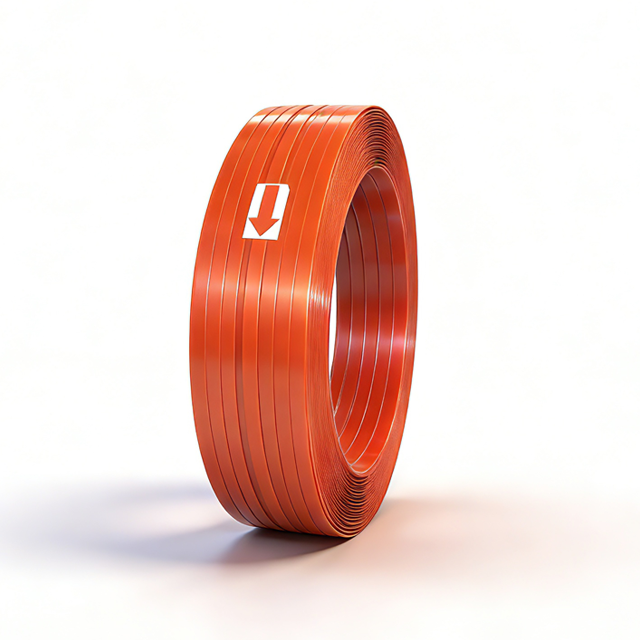
Various industrial sectors rely on these specific PET strap uses to stabilize valuable inventory. Different products behave unpredictably during standard transit operations.
Lumber and timber operations face unique packaging challenges. Wood contains significant natural moisture when freshly milled. It dries gradually over weeks and months. Moisture loss causes the physical bundle to shrink. Metal bands become dangerously loose immediately. A loose bundle collapses easily during truck transit. Plastic actively recovers its tension to compensate. It keeps the entire timber bundle tight indefinitely.
Baling facilities process paper, plastics, and raw cotton. They compress these materials into extremely dense blocks. Compressed bales exert a massive outward expansion force. Expanding materials severely test the limits of your packaging. The plastic safely withstands this intense expansion force.
Brick, block, and paver manufacturers demand extreme durability. Concrete products easily weigh thousands of pounds per pallet. High breaking strength effectively secures these heavy loads. Outdoor storage subjects building materials to constant rain. Metal bands bleed dark rust onto pristine retail bricks. Plastic eliminates this costly aesthetic staining completely.
Palletizing delicate consumer goods requires extreme care. Securing large, unified loads prevents tipping during transport. Metal slices deeply into protective cardboard packaging. It easily crushes aluminum cans and fragile plastic bottles. The softer edges of plastic prevent this costly damage. You maintain perfect product integrity from warehouse to customer.
Applying too few bands for the overall load weight.
Placing bands directly over sharp product corners without edge protectors.
Using worn tensioning tools that fail to achieve maximum tightness.
You must seal this material properly to maintain safety. The friction weld provides the strongest possible seal. Operators use battery-operated friction weld tools constantly. Fully automated arch machines also perform this task. Existing manual steel crimpers will absolutely not work. They cannot secure plastic safely under any circumstances. Metal seals simply slip off smooth plastic surfaces.
Acknowledge the upfront capital expenditure of new battery tools. You balance this initial cost against long-term consumable savings. The transition requires budgeting for proper equipment immediately.
Pay close attention to standard core dimensions. Typical core dimensions measure 16 inches by 6 inches. Your existing warehouse dispensers must match these exact dimensions. The dispenser must also support the coil weight securely. Plastic coils weigh significantly less than steel coils. However, improper dispensers cause coils to unspool erratically. Unspooling creates tangled messes and halts your production line.
You must choose between two primary surface finishes. Embossed materials feature a textured, diamond-like surface pattern. This textured surface provides better grip for specific tools. Certain manual friction weld tools require this texture. However, the embossing pattern slightly reduces overall break strength.
Smooth finishes offer significantly higher tensile strength. Fully automated packaging machines commonly use smooth variations. Heavy-duty machine applications strongly prefer untextured surfaces. Smooth plastic feeds through mechanical arches much faster.
You cannot guess when specifying packaging materials. Calculating required break strength ensures absolute transit safety. You must determine exact strength requirements before ordering supplies.
Determine the total weight of your loaded pallet.
Select an appropriate safety factor based on transit mode. We recommend 1.5 for steady transport and 2.0 for rough transit.
Multiply the total load weight by your chosen safety factor.
Divide that total by the number of bands you plan to apply.
For example, imagine a 2,000-pound pallet of bricks. You choose a safety factor of 1.5 for typical transport. The required containment strength equals 3,000 pounds. If you apply four bands, each band must support 750 pounds safely.
Match physical dimensions carefully to your mathematical requirements. Common widths include 1/2-inch, 5/8-inch, and 3/4-inch variations. Link your load weight directly to the appropriate thickness. Verify your specific tensioning tool specifications before ordering. Tools designed for 1/2-inch bands jam if fed wider materials. Thicker bands resist tearing over rough pallet edges.
Assess camber tolerances accurately for your specific equipment. Camber refers to the slight curvature of the band. If you unroll fifty feet, it might curve slightly left or right. Automated arch machines require strict, low-camber tolerances. High camber causes the band to jam inside the automated arch. Manual battery-tool applications tolerate minor camber variations easily. Hand-grade options usually cost slightly less than machine-grade alternatives.
Our evaluation proves this material dominates modern packaging. It offers the optimal balance of high tension and safety. It delivers unmatched cost-efficiency for heavy-duty packaging needs. It absorbs sudden shocks without snapping catastrophically. It recovers lost tension when timber loads shrink. It effectively removes rust and severe laceration hazards from your warehouse.
We recommend taking immediate action to improve your line. Conduct a thorough load containment audit this week. Evaluate where steel bands currently fail or cause injuries. Request a material comparison cost-analysis from your packaging supplier. Finally, request a sample coil to test on your current machinery. You will quickly realize the operational benefits firsthand.
A: Yes, it is 100% recyclable. Manufacturers often produce it directly from recycled plastic water bottles. Implementing this material strongly supports your corporate ESG goals. Many waste management facilities accept clean coils readily.
A: It has superior retained tension compared to standard PP. Minor relaxation naturally occurs over several months. However, it actively recovers its tension when heavy loads settle. This dynamic recovery keeps pallets safe during long storage.
A: No. Steel tools crimp metal seals onto rigid bands. Plastic requires heat or extreme friction to melt the layers together. Crimping a metal seal onto smooth plastic causes instant slipping and load failure.
A: You should use standard safety strap cutters. Unlike metal, plastic lacks dangerous, explosive recoil when severed. It simply falls away from the load safely. This prevents severe lacerations and eye injuries among your staff.


