

close
Choose Your Site
Global
Social Media
Views: 0 Author: Site Editor Publish Time: 2026-06-30 Origin: Site


Securing heavy, dynamic, or settling loads requires packaging materials balancing extreme tensile strength and operational safety. Traditional strapping methods often fail under modern supply chain pressures. You need reliable performance every single time to protect valuable cargo. For decades, steel served as the default for heavy-duty applications. Today, procurement and packaging engineers actively evaluate plastic alternatives. Rising material expenses and workplace injury liabilities force this industry-wide shift. Legacy metal bands pose massive risks when they snap, rust, or loosen during transit.
This guide breaks down the operational, financial, and mechanical realities of adopting PET Strapping. You will learn how it manages high-payload requirements safely and efficiently. We will explore physical limits, tooling transitions, and specific mechanical advantages. Ultimately, this detailed analysis helps you determine if this advanced polymer fits your exact specification needs perfectly.
Performance: PET (Polyester) offers similar tensile strength to light/medium steel but adds "elongation recovery" to keep settling loads tight.
Safety & Compliance: Eliminates sharp edge hazards and whiplash risks associated with steel bands, lowering workplace injury liabilities.
Cost Efficiency: High strength polyester strapping typically reduces material costs by up to 40% per foot compared to steel, while lowering freight weight.
Implementation: Transitioning requires compatible tensioning tools (battery-operated or pneumatic) and proper edge protection for rigid-angled loads.
Heavy loads undergo dynamic shifting during transit. Products like lumber, metal piping, and concrete bricks expand and contract continuously. Temperature variations and road vibrations cause these microscopic movements. A rigid banding material cannot adapt to these physical changes.
Legacy solutions present significant operational limitations. Steel bands completely lack elasticity. If a timber load shrinks as moisture evaporates, the steel strap becomes dangerously loose. A loose strap compromises the entire pallet. Polypropylene (PP) strapping presents a different failure point. PP degrades quickly under heavy tension. Engineers call this continuous stretching "creep." Furthermore, PP simply lacks the baseline break strength necessary for rigid, high-mass payloads.
A viable packaging strategy must meet strict success criteria. Industry standards dictate specific performance metrics for load containment. Your chosen material must maintain retained tension over long transport times. It must resist environmental degradation from sun and rain. Finally, it must support safe un-banding procedures at the final destination.
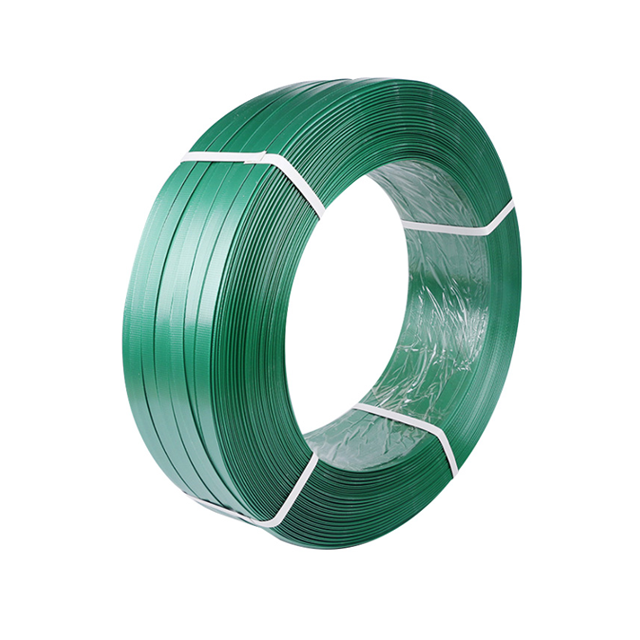
Polyester polymers behave differently than traditional metals. They possess a unique mechanical property called elongation recovery. We often refer to this as material memory. PET stretches slightly under severe impact. This stretch typically ranges from two to six percent. After the impact event passes, the strap recovers its original shape.
This elasticity absorbs sudden shocks during rough transit. Forklift drops or sudden braking will snap a rigid steel band. Polyester absorbs the kinetic energy safely. It keeps tension tight even when loads settle.
Modern extrusion techniques produce incredibly strong plastics. You can confidently replace steel bands in most industrial applications. Break strengths vary based on the strap dimensions. A standard strap might hold 600 pounds. Thicker profiles can secure over 3,000 pounds effortlessly.
Retained tension remains the most critical metric for long hauls. You must ensure the band does not stretch out of shape over weeks in a warehouse. Utilizing heavy duty PET strapping prevents this continuous stretching. It locks the load securely from the origin facility to the final customer.
Environmental exposure destroys inferior packaging materials quickly. Steel rusts when exposed to rain or high humidity. Rust stains ruin finished metal products and high-grade lumber. You lose money on damaged inventory.
Polyester completely eliminates rust concerns. Manufacturers engineer these straps to withstand intense ultraviolet exposure. Carbon black additives often provide extra UV shielding for outdoor yard storage. They perform exceptionally well across massive temperature fluctuations. You can transport goods safely on open flatbed trailers through diverse climates.
Warehouse safety drives many corporate procurement decisions today. Transitioning away from metal drastically lowers injury liabilities. Steel bands pose immediate physical threats during application and removal.
Injury Reduction
Polyester bands do not possess razor-sharp edges. Workers handle them safely without specialized Kevlar gloves. More importantly, polymer bands do not spring back violently. Cutting a highly tensioned steel band creates a lethal "whiplash" effect. This stored kinetic energy routinely causes severe facial and optical injuries. Plastic snaps gently and drops to the floor.
Handling & Ergonomics
Heavy manual labor leads to chronic worker fatigue. A standard steel coil weighs over 100 pounds. Operators struggle to load these heavy coils onto dispenser carts. Back injuries occur frequently during this process. A polyester coil yields the same footage but weighs roughly half as much. This reduction minimizes operator fatigue instantly.
Cleanliness & Disposal
Receiving docks struggle to manage rigid metal waste. Discarded metal bands clutter walkways and puncture forklift tires. Recycling them requires heavy-duty choppers. Conversely, disposing of plastic bands follows a simple, safe protocol:
Workers cut the bands using standard safety shears.
They gather the lightweight strips effortlessly by hand.
Staff places the material into a standard baler.
The compressed bales ship to commercial recycling facilities.
No single packaging material solves every logistics challenge. You must align your material choice with your specific cargo parameters. Reviewing physical limits prevents catastrophic load failures.
Material Capability Assessment Matrix
Application Parameter | Polyester (PET) | Steel | Polypropylene (PP) |
|---|---|---|---|
Shock Absorption | Excellent (2-6% elastic recovery) | Poor (Snaps under sudden impact) | Moderate (Stretches but does not recover) |
Rust Resistance | 100% Resistant | Highly Susceptible | 100% Resistant |
Maximum Break Strength | High (Up to ~3,000+ lbs) | Ultra-High (Up to ~5,000+ lbs) | Low (Typically under 600 lbs) |
Ideal Load Types | Lumber, Bricks, Palletized Metals | Extreme Heat, Sharp Steel Coils | Light Cartons, Newspapers |
Where PET Wins: You achieve immediate cost reductions. You eliminate rust staining entirely. Your workers experience safer daily operations. Shock absorption keeps your settling loads perfectly intact.
Where Steel Prevails: You must retain metal bands for actively hot environments. Hot-rolled steel exceeding 150°C (300°F) melts plastics instantly. Unprotected, razor-sharp steel coils also shear through plastics easily. Extreme payloads beyond maximum polymer break strengths demand steel.
Where PP is Acceptable: Choose PP only for budget-constrained, non-critical tasks. It seals light-duty cartons well. Use it for short-term transit where tension loss remains irrelevant.
Switching your supply chain away from legacy metals requires careful planning. You cannot simply swap the strapping coil and use existing hand tools. The physics of securing plastic differ entirely from securing metal.
You must invest in specialized tensioning equipment. Standard metal crimping tools destroy plastic bands. Modern operations rely on battery-operated tools or pneumatic systems. These devices tension, seal, and cut the band automatically. Upgrading to high strength polyester strapping demands initial capital expenditure (CAPEX) for new tools. However, you recover this investment quickly. The long-term operational savings on consumable materials easily justify the upfront equipment purchase.
Battery-operated tools utilize friction welding to join the strap ends. The tool vibrates the two plastic layers at high frequencies. This friction generates localized heat, melting the polymers together. A properly executed friction weld provides joint strengths between 75% and 90% of the strap's total break strength. This technology completely eliminates the need to purchase metallic slip seals. You streamline your inventory and remove a potential failure point.
Sharp, rigid edges present the greatest threat to polymer bands. Concrete blocks and finished sheet metals possess 90-degree angles. Under extreme tension, these sharp corners act like scissors. They cause premature shear failure. You must implement protective measures. Inserting cardboard, plastic, or fiberboard edge protectors prevents this shearing action entirely. This simple best practice guarantees load integrity.
Procurement teams face numerous product variations when selecting materials. Choosing the incorrect profile wastes budget and endangers cargo. Follow this systematic approach to identify your ideal specification.
Calculate your precise mechanical requirements before ordering. You must divide your maximum load weight by the intended number of applied straps. Next, you must apply a safety margin to account for transit shocks. Industry standards recommend a safety factor of 2x to 3x depending on transport severity.
Safety Factor Calculation Chart
Total Load Weight | Number of Straps | Base Weight per Strap | Required Break Strength (2.5x Safety Factor) |
|---|---|---|---|
2,000 lbs | 4 | 500 lbs | 1,250 lbs |
3,500 lbs | 4 | 875 lbs | 2,187 lbs |
5,000 lbs | 6 | 833 lbs | 2,083 lbs |
Strapping coils wrap around internal cardboard cores. These core dimensions must match your mobile dispenser carts perfectly. An incompatible core renders the coil useless on the warehouse floor. Standard heavy-duty applications generally utilize a 16x6 inch core size. Verify your existing machinery specifications prior to bulk purchasing.
Manufacturers produce bands in two distinct finishes. Smooth textures offer the highest possible tensile strength. We recommend smooth finishes for heavy manual or battery tensioning applications. Embossed textures feature a diamond-patterned surface. This embossing improves flexibility significantly. It reduces splitting and works exceptionally well inside fully automated arch machines. Assess your application method to choose the correct texture.
Upgrading to modern polymer materials represents a highly strategic logistics decision.
This transition directly addresses material budgets, load security, and vital operator safety metrics.
You must carefully match your specific load application to the material's established physical limits.
We strongly recommend conducting a comprehensive "strap audit" within your current facility.
Run a controlled pilot test on a single, dedicated shipping lane before launching a complete supply chain rollout.
A: In about 80% of standard heavy-duty applications (lumber, palletized metals, construction materials), yes. However, extreme high-heat applications or ultra-heavy loads with sharp shearing edges may still require steel.
A: Yes. You cannot use steel tensioners or sealers on PET. You will need battery-operated, pneumatic, or automated plastic strapping machines designed for friction welding or specialized serrated seals.
A: PET performs exceptionally well in standard outdoor weather and freezing conditions. However, prolonged exposure to temperatures above 140°F (60°C) can cause slight tension loss, and it should not be applied to actively hot metal.
A: Yes, PET (Resin Identification Code #1) is highly recyclable. Many warehouse facilities bale used PET strapping for commercial recycling, supporting corporate sustainability initiatives.


