

close
Choose Your Site
Global
Social Media
Views: 0 Author: Site Editor Publish Time: 2026-06-30 Origin: Site


Over-specifying packaging materials continuously erodes valuable profit margins. Conversely, under-specifying load containment limits leads to catastrophic failure and severe safety hazards during transit. Finding the perfect balance ensures your cargo reaches its final destination safely while protecting your operational budget. Many supply chain managers struggle to correctly match dynamic transport forces to specific strap attributes. Relying on guesswork rather than a quantifiable, standard-based framework puts both products and warehouse personnel at risk. You need precise engineering data to make informed packaging decisions consistently.
This guide provides a clear roadmap for determining the exact dimensions and tensile limits required for heavy industrial applications. You will learn how to accurately evaluate equipment compatibility and calculate the necessary safety margins for any shipment. Ultimately, we aim to equip your procurement and operations teams to align load dynamics with exact specifications, ensuring stringent compliance and optimized efficiency using quality PET Strapping.
Matching strap size to load weight requires calculating specific safety factors (typically 1.5x to 2x), not just static weight.
Standard PET strapping sizes (width and thickness) directly correlate with breaking strength, but environmental variables and tension retention also dictate final performance.
Regulatory and transport compliance (such as AAR certification) introduces a necessary baseline for evaluating high-performance PET against generic alternatives.
Selecting the right strap requires concurrent evaluation of existing strapping machinery (manual, pneumatic, or automated heads) to avoid implementation friction.
Understanding load dynamics is the first step in packaging engineering. Static load refers to the resting weight of a pallet sitting on a warehouse floor. At rest, gravity is the only force acting upon the load. Dynamic load introduces motion. It accounts for the intense G-forces exerted during sudden stops, sharp turns, vibrations, and vertical drops in transit.
A pallet might weigh 1,000 pounds statically. However, a truck braking hard at 60 miles per hour can easily multiply that force. If you base your strapping decisions solely on static weight, your packaging will fail on the road. You must engineer your containment strategy around dynamic shifts to prevent cargo from breaking loose.
Breaking strength alone does not guarantee a secure load. Tension retention and elongation recovery are equally critical. PET (polyethylene terephthalate) possesses unique elastic properties. When a forklift moves a heavy pallet, the load shifts and settles. PET elongates slightly to absorb the shock.
More importantly, it recovers. This elastic memory allows the strap to shrink back as the load settles. It keeps the package tight over long distances. Relying only on raw tensile strength ignores this crucial recovery phase. Without elongation recovery, settling loads become loose, allowing internal friction to damage the goods.
Miscalculating strap specifications carries severe operational risks. Many companies mistakenly apply steel-strap assumptions to plastic packaging. Steel offers incredibly high tensile strength but zero elongation. When steel encounters a massive dynamic shock, it snaps. When PET encounters the same shock, it stretches.
If you ignore these physical differences, you face two primary hazards. Over-engineering leads to massive material waste. You end up buying thicker, more expensive straps than necessary. Under-engineering leads to cargo damage. Broken bands result in spilled products, rejected deliveries, and compromised warehouse safety.
Securing a load mathematically eliminates dangerous guesswork. The packaging industry relies on a standard equation to determine the baseline strength required for any given application. You can calculate your minimum threshold using this simple formula:
(Total Load Weight × Safety Factor) ÷ Number of Straps = Required Break Strength per Strap
Consider a practical example. You need to secure a 2,000-pound pallet using four straps. If you apply a safety factor of 1.5, the calculation is (2,000 × 1.5) ÷ 4. This means each strap must deliver a minimum break strength of 750 pounds. This mathematical approach guarantees consistency across your shipping operations.
The safety factor acts as your dynamic buffer. It accounts for the unpredictable nature of global logistics. You cannot use a universal multiplier for every product. You must select a safety factor based on the specific geometry and stability of your load.
Safety Factor 1.5: Use this multiplier for stable, highly uniform loads. Standard corrugated boxes stacked evenly on a pallet fit this category.
Safety Factor 2.0: Apply this multiplier to rigid, heavy items. Bricks, steel pipes, and cinder blocks require this higher margin.
Safety Factor 2.5+: Reserve this high multiplier for expanding loads. Baled fibers, compressed lumber, and highly volatile export shipments need maximum dynamic protection.
A strapping band is only as strong as its joint. Whether you use a friction weld, a heat seal, or a metal clip, the joint becomes the weakest point of the loop. Operations managers often overlook this crucial detail when sourcing materials.
A standard friction weld typically retains between 75% and 90% of the stated PET strap breaking strength. If your formula requires a 750-pound break strength, a strap rated exactly for 750 pounds will fail at the joint. You must inflate your initial requirement to compensate for joint efficiency loss. Always audit your sealing tools to ensure they produce optimal weld integrity.
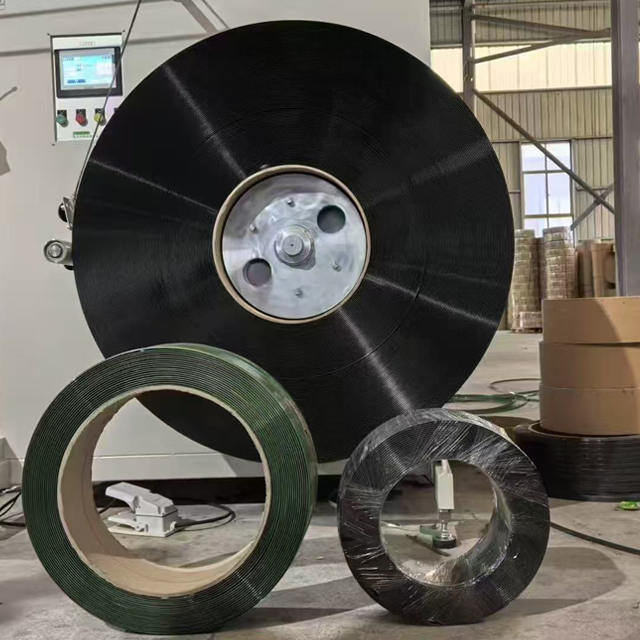
Different industrial applications demand specific dimensional profiles. Proper specification requires mapping your load dynamics to precise physical dimensions.
Duty Category | Typical Width | Typical Thickness | Average Breaking Strength | Ideal Use Cases |
|---|---|---|---|---|
Light-to-Medium | 3/8” – 1/2” | .015” – .020” | 400 – 600 lbs | Corrugated boxes, standard unitizing |
Heavy Duty | 5/8” | .030” – .035” | 900 – 1,400 lbs | Brick, block, heavy metals |
Ultra-Heavy Duty | 3/4” – 1” | .040” – .050” | 2,000+ lbs | Export shipping, rail transport |
Light-to-medium profiles usually measure between 3/8-inch and 1/2-inch in width. The thickness ranges from .015 to .020 inches. These dimensions typically yield an average breaking strength between 400 and 600 pounds. This category serves perfectly for high-volume, low-impact applications.
You will frequently see this category securing corrugated boxes, light beverage pallets, and standard retail unitizing. It provides excellent elasticity for settling goods without adding unnecessary bulk. Choosing appropriate PET strapping sizes in this tier ensures your automated arch machines run swiftly without jamming.
Heavy-duty bands step up the physical dimensions to handle rigorous industrial environments. These straps generally feature a 5/8-inch width. Thickness levels increase to a range of .030 to .035 inches. The resulting breaking strength lands between 900 and 1,400 pounds.
This profile aggressively replaces light steel banding. Applications include securing brick, concrete blocks, raw lumber, and heavy metal components. The heavy-duty tier offers the perfect intersection of steel-like containment and plastic-like elongation. It absorbs massive dynamic shocks during flatbed truck transport without snapping.
When load failure is simply not an option, ultra-heavy duty profiles take over. Widths expand to 3/4-inch or even a full 1-inch. Thickness peaks between .040 and .050 inches. These massive straps consistently deliver break strengths exceeding 2,000 pounds.
These specifications handle extreme industrial abuse. Common applications include long-haul export shipping, heavy machinery tie-downs, and high-expansion agricultural baling. Rigorous rail transport heavily relies on this tier to survive violent train car coupling impacts. They provide uncompromising security for the world's heaviest commercial loads.
Navigating the global rail network requires strict adherence to specialized safety guidelines. The American Association of Railroads (AAR) establishes the definitive benchmark for transport packaging. AAR approval signifies that a strapping product has survived rigorous independent laboratory testing.
AAR testing evaluates impact resistance, joint strength integrity, and performance under extreme high-temperature conditions. Railroad transit introduces violent horizontal shocks during train yard coupling. If a material earns AAR certification, it proves it can absorb these massive kinetic spikes without compromising the cargo layout.
Not all plastic coils deliver the same reliability. A glaring performance gap exists between AAR-approved products and non-certified, ordinary alternatives. Lower-grade bands often use highly inconsistent recycled resins. This chemical inconsistency creates unpredictable weak points throughout the coil.
Ordinary plastics frequently compromise both raw tensile limits and elongation recovery. A cheap strap might hold initial tension on the warehouse floor but permanently deform after one sharp highway bump. Certified options utilize tightly controlled resin blends. They ensure predictable, uniform performance from the first foot of the coil to the last.
Large-scale operations often require bespoke physical attributes. You can specify various custom features without compromising structural integrity. Common B2B specifications include varied core sizes to match proprietary dispensers and custom colors for visual inventory routing.
Printed branding adds a layer of security against tampering. Furthermore, you must choose between embossed and smooth finishes. Embossing increases the surface friction, which aids the feeding mechanism in certain automated machines. However, deep embossing slightly reduces the overall cross-sectional mass, slightly altering the maximum tensile yield compared to completely smooth variants.
Even the strongest packaging materials fail if deployed with incompatible equipment. You must perfectly match your material dimensions to the specific tolerances of your application tools. Using a 5/8-inch strap in a tool calibrated for 1/2-inch causes instant misalignment and joint failure.
Different tools interact with plastic differently. Battery-powered friction welders require precise thickness to melt the polymer correctly. Pneumatic tensioners rely on high air pressure to pull the strap tight before sealing. Fully automated arch machines demand flawless stiffness and straightness to shoot the strap around a pallet in milliseconds. Alignment between consumable and hardware is mandatory.
Operational bottlenecks emerge when hardware and consumables clash. Camber is one of the most destructive feed risks. Camber refers to the slight horizontal curvature of a strap unspooling from a coil. Excessive camber causes the band to miss the machine's catch plates, jamming automated tracks instantly.
Dust accumulation presents another hidden danger. Heavily embossed surfaces generate micro-shavings as they scrape through tensioning wheels. Over time, this polymer dust clogs weld plates and sensor optics. Routine maintenance and selecting a strap with an optimized surface texture will drastically reduce these unexpected machine faults.
Never transition your entire procurement contract based on a datasheet alone. Operations managers must validate new materials on the floor. Conducting a structured pilot test minimizes implementation risks.
Joint Integrity Checks: Pull a sample weld apart manually. Ensure the weld surface shows proper melting rather than superficial scratching.
Drop Testing: Subject a strapped test pallet to a controlled forklift drop to measure dynamic shock absorption.
Transit Trials: Send a mixed load on a standard truck route. Inspect the tension retention immediately upon arrival.
Hardware Audits: Run 100 cycles through your automated arch to monitor for dust buildup and track jamming.
Specifying the correct packaging materials requires a carefully calculated balance. You must harmonize load geometry, expected transit rigor, and specific equipment compatibility. Relying on baseline equations and established safety factors removes the guesswork from supply chain logistics.
We recommend conducting an immediate final audit of your current load weights against your actual joint seal efficiency. Verify your safety multipliers and inspect your friction welding tools. Small adjustments in your procurement parameters yield massive improvements in transit security and material efficiency.
Take action today to optimize your load containment strategy. We invite you to request a dedicated technical consultation with our engineering team. Submit your exact load parameters, and we will perform a custom sizing calculation tailored to your facility. Alternatively, reach out to request AAR-certified sample coils for your own in-house pilot testing.
A: Steel possesses a higher ultimate tensile limit but zero elasticity. When subjected to dynamic shocks, steel bands snap under pressure. PET features slightly lower raw strength but superior elongation and recovery properties. This elastic memory allows plastic to absorb transit impacts and keep shrinking loads completely tight, making it vastly more effective for dynamic transport.
A: Yes, extreme temperatures impact polymer performance. High heat can soften the resin, slightly reducing tension retention over extended periods. Freezing conditions make the plastic more brittle, increasing the risk of shearing. However, high-quality, certified resins maintain baseline operational thresholds across standard global shipping climates effectively.
A: Embossing adds a textured diamond pattern to the strap's surface. This texture improves grip for machine feed wheels and tensioners. Smooth variants lack this texture, making them slightly stiffer. Because embossing displaces material, a smooth strap of identical width and thickness will generally offer a slightly higher ultimate tensile yield.
A: Generally, no. PET has a much higher density and melting point than polypropylene. A standard PP machine lacks the heavy-duty tensioning power and the elevated heating temperature required to properly weld PET. Attempting to use mismatched materials will result in weak joints, excessive jamming, and compromised load security.


